
The pastor, who is a member of the provocative evangelical sect The Universal Church of the Kingdom of God, appeared on the Madonna’s feast day (October 12, a state holiday) to protest the nationalized iconophilia that his brand of Christianity found so objectionable. After raining down a long tirade of (presumably, I don’t speak Portuguese) insults, Von Helde sealed his fate and a national scandal by proceeding to hit and kick the statue.
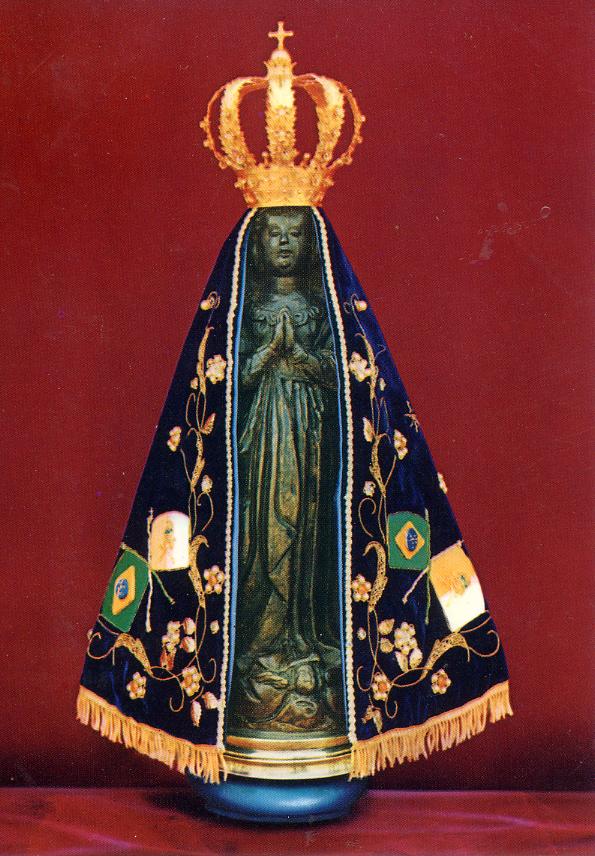
The fact that this idol-breaking was televised is not particularly interesting, for of course mass media (and especially television) means that images are able to traverse large courses, armed with powers alien to their origins. What did pique my interest was the way the TV cameras went in for a well-lit closeup of the lifeless, clay image’s face, as if it were just as valid a “participant” in the broadcast as the iconoclast in the ill-fitting suit. There’s a paradox growing here, a kind of seduction, between both the image and the TV cameras, and the image and Von Helde (the fact that the Virgin’s title means “appeared” is a nice little wink directed at us). A certain ambivalence, sliding between belief and unbelief, in the same manner as the stories about American soldiers urinating on Korans in order to agonize their Muslim charges. The moment they choose to do so, aren’t they giving a little magic to their target? For we don’t kick bicycles or buildings to show people that they’re, in fact, merely bicycles and buildings. And in the light of the secular American military, the Koran is just a book, and defiling it (or any book) is madness. Committing heresy, whether one "believes" or not, involves a little bit of self-bewitchment. Von Helde attacks the image because he believes it has fatally seduced his countrymen, hypnotized them from God, but in this interaction he enters into its game, he gives it credence in a manner that not merely any object could allow.
What’s more, in the light of TV Von Helde is himself an image asking for credence, so we have images-within-images, deep vertigo, like Videodrome’s Father O’Blivion appearing on a talk show in the form of a television. Von Helde surely knew what consequences would follow his broadcast, albeit perhaps not on the scale that was to follow. Brazilian Catholics responded by attacking several UCKG buildings, and Von Helde holed up in South Africa until the fervor died away. He believed that images were bewitching Catholics, but what he didn't realize was that the sorcery went far beyond merely religious commitment. The scandal could not have been possible if it were not for the idolatry, the reality, of television.


No comments:
Post a Comment