
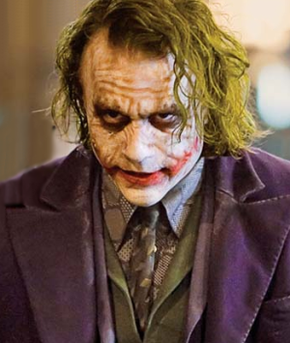
Fuck, yet another thing about a damn movie. I don't think there are significant spoilers in this, but it wouldn't hurt to avoid it if you haven't seen the amazing film in which the above image plays a key part.
In his review of Christopher Nolan’s sophomore bat-flick The Dark Knight, Globe & Mail columnist Liam Lacey remarks on a delicious character detail of the late, great Heath Ledger’s final role:
“At various points, he offers different versions of how he acquired his traumatic facial scars, as if to suggest the whole notion of a coherent psychological history is a tedious fiction.”
All throughout watching this fantastically enjoyable movie (A+), I couldn’t help but think (yet) more about Baudrillard’s concept of seduction. The Joker appears quite obviously to be a sadistic, unhinged maniac, yet it’s impossible to deny his cunning and his uncanny ability to devise traps-within-traps-within-traps. He might not actually be crazy, but ridiculously intelligent, and perhaps even (ultimately) motivated by something, which he staunchly denies. By assuming an air of total randomness, total arbitrariness with regard to his criminal deeds and totally without meaningful motive, the iconic villain can hope to cover up his tracks. He hides behind this web of signs (insanity, chaos, death etc), which erases the meaning of his acts just as his makeup erases the meaning of his face. Like a seductress, he uses empty signs to ensnare others. And, along the lines of Baudrillard's claim that seduction is always a two-way street, we give him this power by treating him as such. Like a seductress, he knows that the game is all that matters, and because he can control the game, draw us into his court, he acquires power.
I think we might look at Ledger’s take on the Clown Prince of Crime as the end result of what the 90s blockbuster villain first presented. Bad action movies have bad villains. They’re bad because, while they may make pretensions to be motivated by some reward such as money, power, or ideology (Wild Wild West comes to mind in the latter case), their reasoning is often weak, they never seem to be quite there; but more cookie-cutter versions of themselves, empty foes for the heroes to thwart. They topple over buildings and scatter policemen with child’s abandon, but it’s all very much covered in this glaze of irresponsibility, a certain non-threatening theatricality that was central to a 90s summer blockbuster, as was the arbitrary pop single playing over the end credits.
Of course, the 90s are over, and we’re solidly in the post-Matrix age of action filmmaking. The Joker, and really all costumed characters, seduce us. He enters the criminal world as already something covered up, something deflected, and his strategy for this deflection is to assume the caricatured form of the bad action movie villain. Just like an actor putting on a costume, he’s assuming a certain kind of social role. He plays by the exact same rules as the 90s villains, but because it’s entirely put on, he becomes SO much more powerful, and so much harder to pin down.
Because it IS a mask, we are drawn towards it. The Joker’s theatricality is not his base, but rather it is a property of his appearance. We can see this in the way that he changes his stories around (like a self-referential plot hole) and in the way that he baroquely racks up huge body counts, but this time the deaths come with real moans of agony alongside the crescendos. As demonstrated, he issues the exact same signs as his 90s associates, but he does this in order to disappear.
In his seminal work with the Joker (and the DC Universe at large), Grant Morrison suggested that the character might not be insane, but in fact “super-sane,” a chaotic network of motiveless motives arranged to combat the schizophrenic realities of modern urban life (especially so in a city like Gotham). Likewise, Ledger’s Joker, a real bastard if there ever was one, retreats behind his signs in order to enter the symbolic universe, the syntax, of movies and of superheroes. In this state, he is invulnerable.


No comments:
Post a Comment